

Advertise to 40,238 E-Commerce Businesses
Promote your tool, service or upcoming event - Reach Founders
Good morning!
In today’s newsletter,
Final call: AI agents are becoming your next acquisition channel
The subscription math that got Spot & Tango to $100M
252 Micro-Influencers. No Cash. 10× Sales.
AI Launch Codes: Why Your 10 Ads Are Only Getting 2 Shots at the Auction
This issue takes 2 minutes to read.
Check out our DTC tool stack here
Let’s dive into it👇
Free workshop
Final call: AI agents are becoming your next acquisition channel
Final Reminder
Tomorrow we’re discussing the next big shift in ecommerce discovery.
Over the past week, hundreds of operators from the newsletter have registered for the session:
Mastering AI agents for organic traffic over the next decade
Delivered tomorrow at 10am EST by Ankur Modi (ex-Meta, Ex-Amazon systems architect, & NASDAQ IPO veteran) with live Q&A.

Because a quiet but important change is happening.
Customers are starting to delegate buying decisions to AI systems.
Instead of searching, opening ten tabs and then comparing products, they simply ask AI: “Which brand [of X] should I buy for [Y]?”
The AI doesn’t show a page of results.
It recommends a handful of brands it trusts…which raises a new question most ecom teams have never had to ask before:
How does AI decide which brands it trusts?
That’s exactly what we’ll explore during the session.
WHAT WE’LL COVER
Why AI-mediated discovery is accelerating
Why many large brands are harder for AI systems to interpret than smaller stores
The emerging “agentic commerce protocol” shaping the next decade of ecommerce
What infrastructure your brand will need to win when (not if) AI agents become a new acquisition channel
Plus:
We’ll open the floor to live Q&A about catalog scale, AI discovery and data infrastructure.
Bonus for attendees
10 attendees that stay until the end get a free AI-visibility audit, showing:
How accurately AI systems interpret your catalog today
What pages AI cites and how often
Where data inconsistencies in your catalog might confuse AI models
Any other gaps in your current strategy
Retention Recipe
The subscription math that got Spot & Tango to $100M
Most DTC brands look at ROAS (Return On Ad Spend) to decide whether marketing is working. Spot & Tango uses a different number entirely.
They call it Return on Invested Capital. Here's how it works.
Take your marketing spend. Say it's $1M. The question isn't "what did it generate this month."
The question is: how quickly does that $1M get paid back, and how long until it generates $1M in profit?
To answer that, you need three numbers:
Average revenue per customer per year (your LTV numerator)
Contribution margin per customer per year (LTV multiplied by margin)
Customer acquisition cost
Divide 2 by 3. That tells you how many years it takes to break even on your acquisition spend.
Everything the business does, retention, product innovation, pricing, and channel mix gets evaluated against that timeline.
The implication for subscription brands: a customer who churns 10 days after their first order isn't just a loss on that order. They blew up the entire ROIC calculation. Every dollar you spent acquiring them is unrecovered.
That's why Spot & Tango treats second-order and third-order churn as a company-wide metric, not just a retention team problem. If churn is high, your CAC ceiling drops. If you improve retention, you can spend more to acquire customers and still hit your profitability timeline.
This is the framework that let them grow to 9 figures while staying profitable from nearly the beginning.
Action Summary:
Calculate your average revenue per customer per year multiplied by your contribution margin. That's your annual profit per customer.
Divide by your CAC. The result is how many years it takes to break even on each customer you acquire.
If that number is over 18 months, retention is your biggest growth lever, not acquisition.
Pssst…by upgrading to AI Launch Codes, you can unlock $195 worth of Magicals for free
Ask An Expert
What’s the biggest challenge in your business right now?
Let us know by simply replying to this email, and we’ll have an expert reach out to you and answer that, and you can also expect to receive some helpful resources.
Influencer Marketing
252 Micro-Influencers. No Cash. 10× Sales.

Naked Sunday was stuck: low velocity, buried in Amazon search, barely any reviews. They activated 252 micro-influencers through Stack Influence — creators who actually purchased the product on Amazon, tried it, and posted authentic UGC. No cash fees. Just product.
4 months later: 10× monthly sales, jumped 25,000 spots in Beauty & Personal Care rankings, 1.4M social impressions, and 57 organic product testimonials.
The model is simple — influencers buy your product with their own Amazon accounts, generating real purchase velocity that the algorithm rewards. You keep the UGC rights, the ranking boost, and the review momentum. Brands like Magic Spoon, Unilever, and MaryRuth Organics use it to hold page-1 positions.

Why Your 10 Ads Are Only Getting 2 Shots at the Auction
CTR drops. Frequency climbs. The obvious read: people saw your ad too many times and tuned out.
So you make something new. Fresh hook. Different thumbnail. New creator. Same result a week later.
Creative fatigue is a real thing. But that's not what's happening here.
The real problem: Entity ID clustering
Andromeda, Meta's ad retrieval system, reads your creative at the pixel level using Vision-Language Models. It classifies colors, faces, objects, text, audio, and aesthetic style. Based on that, it assigns each ad an Entity ID.
Ads that look or sound similar get grouped under the same Entity ID.
One Entity ID means one ticket into the auction.
Your 10 ads might only have 2 tickets. Which means 8 of them are invisible. Not underperforming. Invisible. They never got the chance to compete.
This is also the reason you keep hearing the term Creative Diversity.
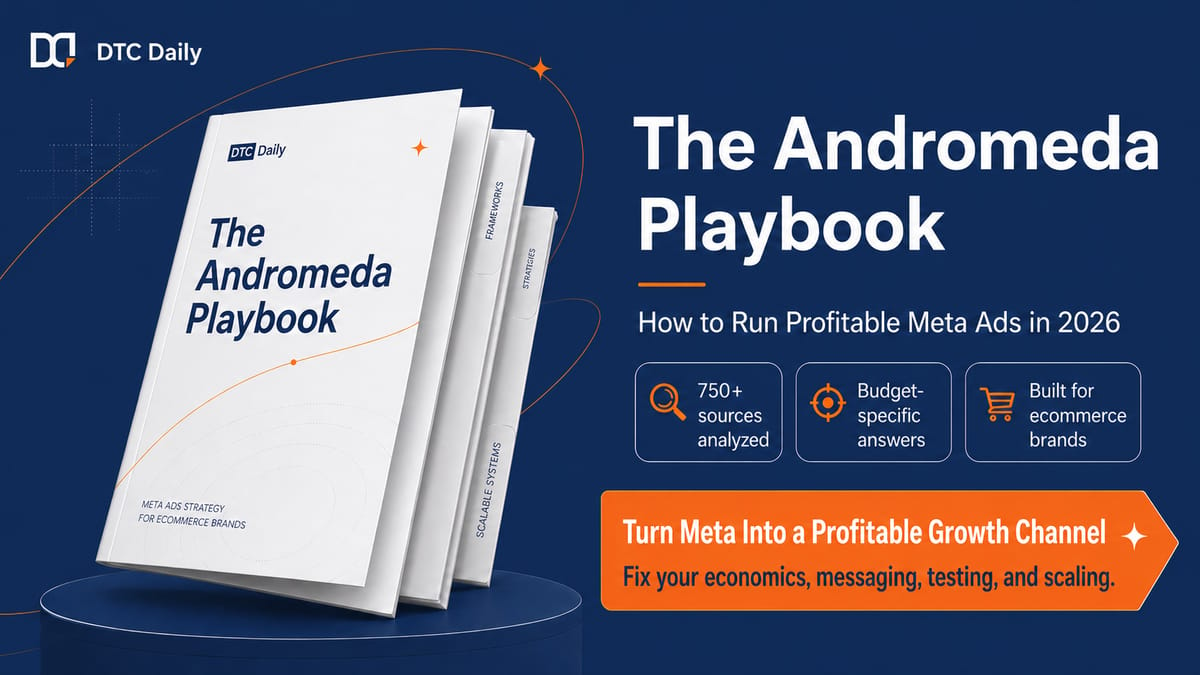
We have covered this topic in complete detail in our Andromeda Playbook. You can purchase it using the link below.
Fraser Cottrell mapped the 4 levers Andromeda uses to classify your creative:
Persona — who is in the ad, or who it speaks to
Messaging — the core selling angle, the reason to buy
Hook — the opening that stops the scroll
Format — video, static, carousel, UGC, demo, comparison
Change at least 2 levers and Andromeda treats it as a genuinely different ad. Change only 1 and you're back in the same cluster. Where most accounts lose:
New hook, same video body → 1 lever → same Entity ID
Same founder, different room → 1 lever → same Entity ID
Same image, different copy overlay → barely counts. Vision-Language Models weight visual content heavily.
The test before you upload anything: would a stranger see this and your existing ads as meaningfully different products or approaches? If not, it's an iteration.
Why running 90% iterations means you plateau
Nick Theriot's framework for what a healthy Meta creative library looks like:
40% Iterations — same ad, change one variable. Keeps winners alive.
40% Variations — same message, different format.
20% Net New Concepts — entirely new persona, message angle, or format category.
Most accounts run 90% iterations. The 20% net new is where Andromeda finds new audience segments it can't reach with your existing creative. Without it, you're shuffling existing demand. You're not growing the pool.
The ceiling proof
John Moran at Tier 11 documented what a creative ceiling actually looks like in a real account.
The brand scaled to $250K/month on UGC alone. Then it stopped. More UGC didn't help. Better UGC didn't help. The problem wasn't execution. It was category.
All UGC falls into the same format categories. One category reaches one cluster of audience segments. When those segments are exhausted, you're done no matter how many new videos you shoot.
The fix was adding Us vs. Them ads and Product Feature ads. Different categories. New Entity IDs. Audience segments the algorithm hadn't touched yet.
New Customer Acquisition Cost dropped 25%.
One format category is one audience ceiling.
The hard part
We all know we need creative diversity, but it’s super hard to actually do it in practice.
It feels like a big creative project with no clear starting point, and we just keep running out of ideas.
So we built a 3-prompt AI workflow.
1. It audits your current library against Fraser Cottrell's 4 levers
2. It identifies which of John Moran's 9 format categories you're missing
3. It writes production-ready briefs for 3 net-new concepts
Specific enough to hand to a creator or shoot yourself this week.
The 3-Prompt Creative Diversity System
Run these three prompts in order. Each builds on the last.
Before you run these, gather your current running ads:
- Video: paste the transcript
- Static/image: upload the image directly into Claude
That's it. The prompt tells Claude to analyze what it sees.
Prompt 1: The Creative Audit
This identifies which of Fraser Cottrell's 4 levers each ad uses and flags what Andromeda is likely clustering together.

This post is for paid subscribers
We built AI Launch Codes to help you scale smarter. We test AI tools, build workflows, and write prompts—so you don’t have to. But testing takes time, money, and effort. This paid upgrade helps us keep experimenting, while you get the winning playbooks delivered straight to your inbox.
UpgradeWhy You’ll Want It:
- Use AI to scale faster, cut costs, and boost efficiency
- Ready to use workflows, automations and prompts
- Real world use cases, no theory