
In partnership with

Good morning,
Your Black Friday offer is live. Your customer likes the product. And they’re still waiting.
Because you’ve spent weeks telling them the biggest sale is coming. Why risk buying too soon?
Today, we look at how two retailers remove that worry, then break down two ads that give shoppers a reason to care beyond the discount.
Today: We examine early-purchase hesitation, catch five holiday developments, share three ecommerce posts and steal two ad ideas before preparing your busiest support answers.
Presented by Gladly.ai
A Single Typo Shouldn’t Cost You a Sale

A shopper types “running shos” and gets nothing back. Another types “red waterprof trail runners under $150” and hits the same wall. Both knew what they wanted.
Traditional site search relies on exact keyword matching, leaving shoppers stranded at “0 results found” screens.
Gladly understands what shoppers mean, typos and all. Instead of a dead end, they get products that fit what they asked for and a conversation that keeps them shopping.
While You Were Building
In the Headlines
Shoppers started early. They’re still coming back for Thanksgiving weekend. NRF expects 182.7 million consumers to shop over the weekend; 60% had started by early November. Give your early campaign and your weekend campaign distinct reasons to buy.
Amazon is giving shoppers reasons to return throughout its sale. Daily themed offers lead into two deal drops on Black Friday and Cyber Monday. What changes during your campaign besides the countdown?
Instacart makes the turkey the incentive for the whole basket. Its November 18–22 offer provides up to $40 towards an eligible turkey with a $50 basket minimum. The turkey counts towards that threshold. One timely hero product helps sell the surrounding purchase.
Salesforce forecasts $357 billion in Cyber Week online sales. It expects AI and agents to influence $75.8 billion. That includes influence before purchase, not just purchases completed inside an AI assistant.
Thanksgiving removes a day from normal USPS delivery. Regular delivery and retail services resume November 27. Check that your dispatch promises account for the holiday before order volume climbs.
On Socials
1/ Cheaper traffic doesn’t mean stronger demand.
Bryan Bumgardner discusses improving Meta auction economics without a corresponding conversion-rate improvement in the data he follows. Separate what changed in traffic costs from what changed in buying behaviour before scaling.
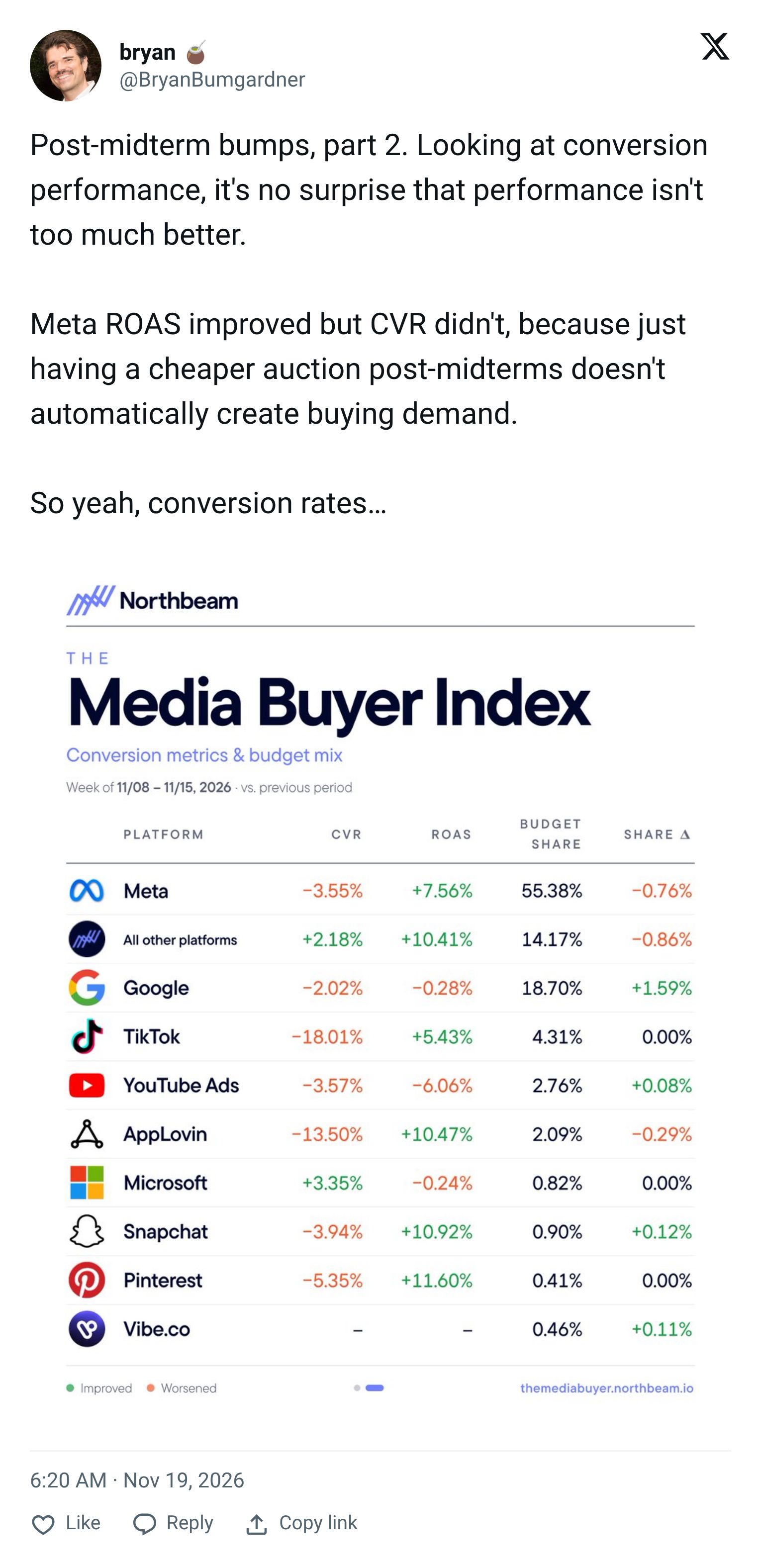
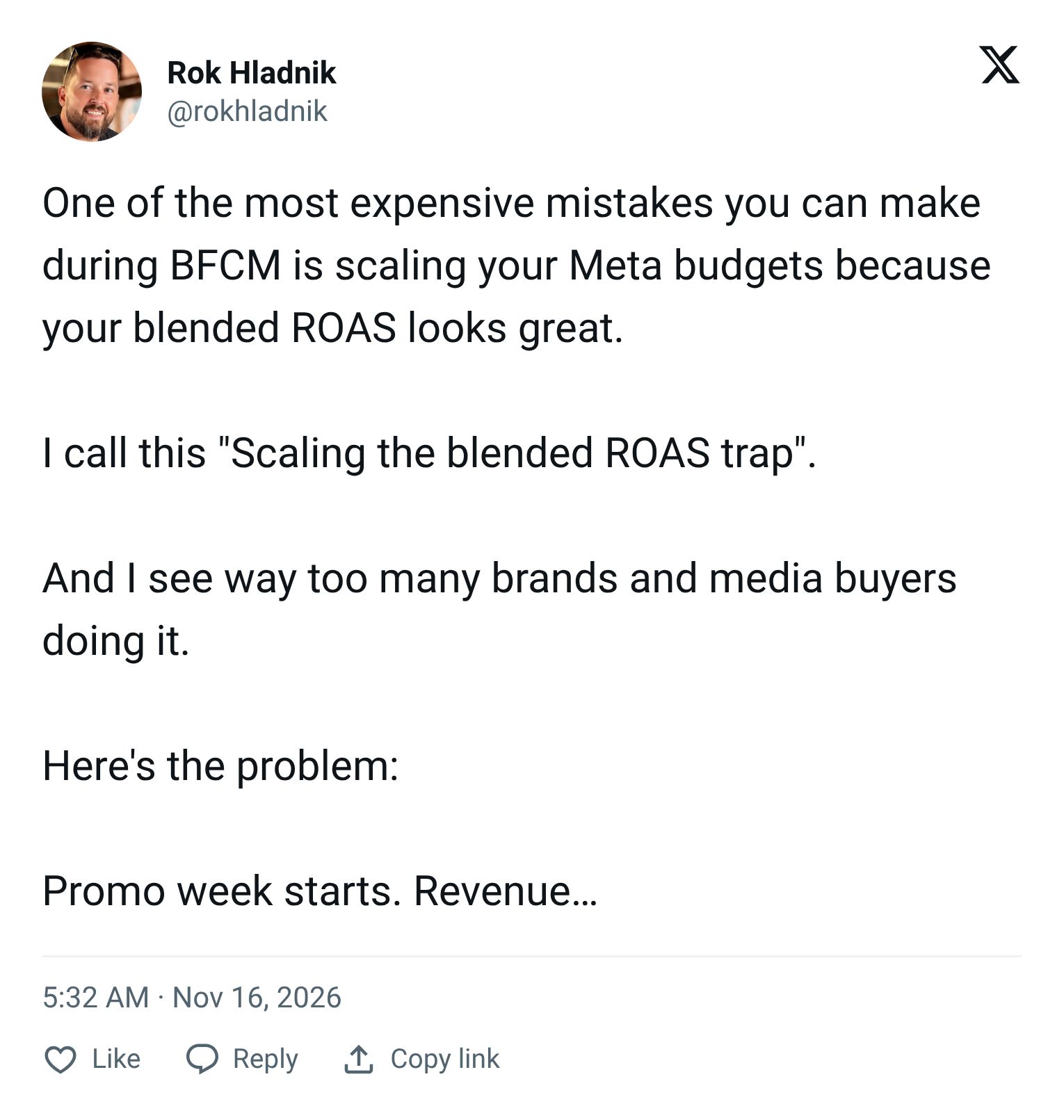
2/ Your Black Friday ROAS could be flattering your acquisition.
Rok Hladnik explains how returning customers, email and existing demand can lift blended results while additional acquisition becomes less profitable. Check new-customer economics before raising budgets.
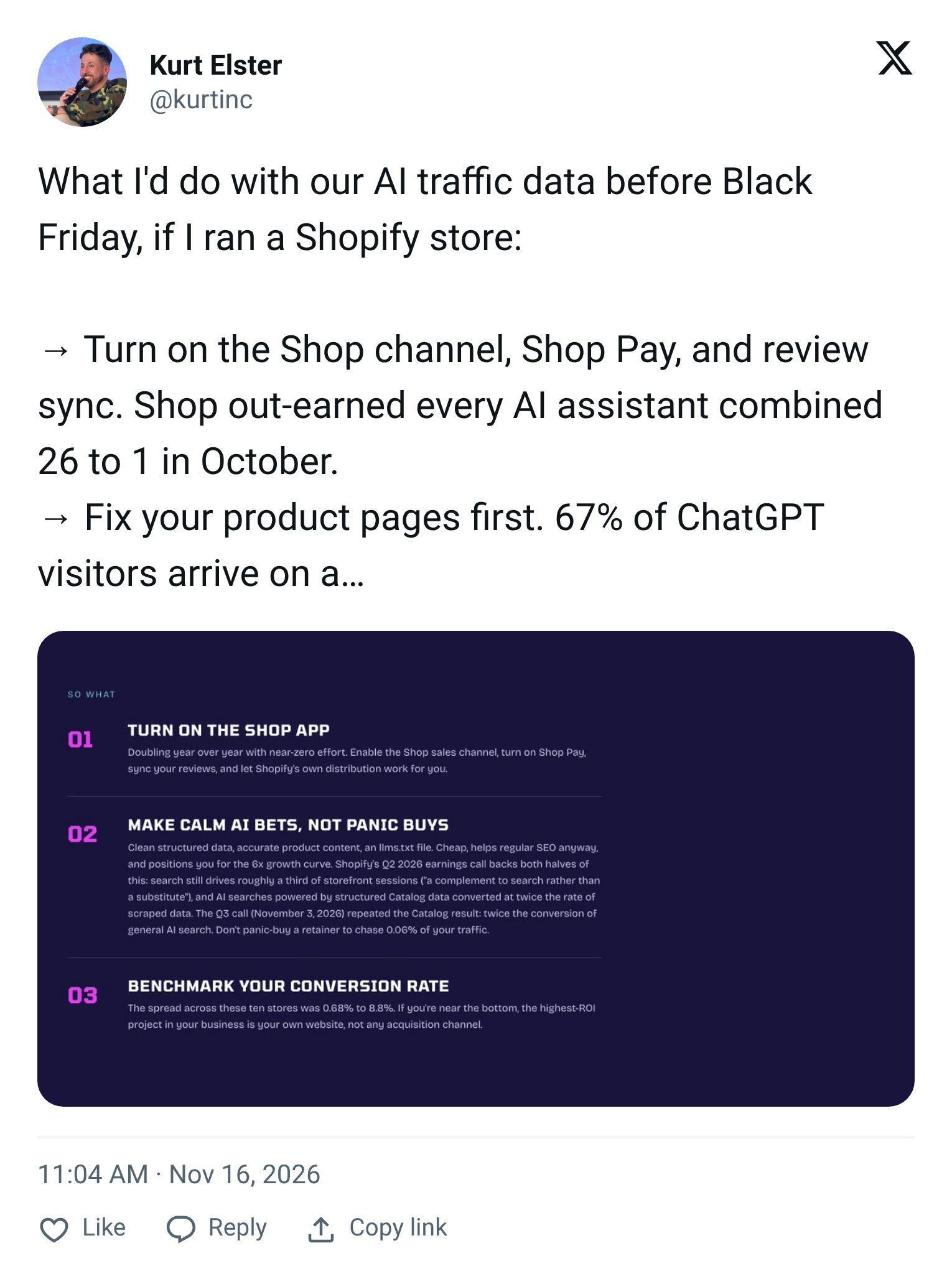
3/ Check where your holiday shoppers actually come from.
Kurt Elster compares AI referrals with other shopping sources across a small store sample. Check your own revenue by source before diverting attention from channels already producing purchases.
Today’s Deep Dive
Are You Teaching Customers to Wait?
You announce an early Black Friday sale. Then you remind everyone that Black Friday itself is still coming.
A shopper can like the product and the price, yet hesitate over one question: what if it gets cheaper next week?
Another countdown won’t answer that. A clear price promise can.
Argos takes the risk out of buying early
Its guarantee covers products carrying a specific badge. If the displayed price falls before midnight on December 25, eligible buyers receive the difference as an e-gift card.
The rules matter: buyers must provide an email at purchase, and the voucher lasts three months. It is a bounded promise, with a defined product set and end date.
Newegg removes another job: checking the price

Newegg makes the reassurance part of its early-shopping pitch.
Newegg’s 2026 campaign went further: its system checks eligible purchases and automatically returns qualifying price differences to the original payment method.

The purchase window ended November 18. This is a worked campaign example, not an offer readers can newly enter today.
The comparison period runs through November 28, with refunds due by December 8. Customers do not have to keep checking and submit a claim.
What to copy
Start with the hesitation your own campaign creates. If shoppers expect a better price later, consider a narrow guarantee you can honour.
Choose eligible products. Start with a small set whose pricing you control.
Model the downside. Calculate the cost if you later reduce every eligible item to your planned lowest price.
Define the promise. State the window, exclusions and whether the difference comes back as cash or credit.
Make redemption clear. Put the process beside the offer, then repeat it in the order confirmation.
The examples show the mechanism, not a proven conversion lift. Test it against your own margins and buying behaviour.
Before giving shoppers a bigger discount, remove their reason to wait.
Ideas Worth Stealing
1. Ketone-IQ: Lead with the objection customers already have

Original static ad from Funnel Library. The objection becomes the hook.
Most brands would bury complaints about taste.
Ketone-IQ opens with them: “We’re sorry. About the taste, NOT the deal.” It explains its functional positioning before introducing the Black Friday offer.
Why it could work: It addresses a reason someone might hesitate before asking them to buy.
How to replicate it: Find a recurring review objection. Acknowledge it, explain the genuine trade-off and who the product suits, then introduce the offer.
The discount gets stronger when you first resolve the doubt.
2. NOBL: Make the bundle’s value visible before showing the saving

NOBL maps three travel frustrations to three product answers.
NOBL doesn’t just put several suitcases beside a discount.
Its comparison connects travel problems to product answers: mismatched bags, packing chaos and splitting zippers become a matching set, packing cubes and zipperless cases.
Now the bundle has a purpose.
Why it could work: Each component earns its place. The shopper can see what the purchase changes.
How to replicate it: Choose one customer situation. Show three specific frustrations beside three demonstrable fixes in your bundle. Then reveal the offer.
Sell the job the bundle completes before selling how much it saves.
These are creative mechanisms worth testing. Library visibility does not establish conversion performance.
Daily Growth Rep
🎯 Today’s Growth Rep: Prepare your three busiest support answers
Turn your most common sale questions into three ready-to-use replies.
Why this works:
Customers get consistent answers while the team is busiest.
Clear eligibility, delivery and returns information can resolve hesitation before checkout.
Your rep:
Review recent support messages. Pick the three most repeated questions.
Write a short reply for each using the actual promotion, dispatch and return rules. Link to the relevant page.
Save them in your support tool and ask a teammate to check each answer against a realistic customer question.
Report: “Three holiday support replies are saved and checked.”
Make the right answer easy to send.
In Case You Missed It
How to sell the same product to different buyers · Real ads from Grüns, Vessi and Eight Sleep show how the buying reason changes the creative.
That’s it for today. Reply and tell me: what is the biggest reason customers hesitate over your holiday offer?
Kaushal
DTC Daily