
Good morning,
A Black Friday deal can earn the click. Then the shopper asks a harder question: is the product worth buying at all?
Hollow’s four-pair sock offer makes that tension easy to see. Today’s Deep Dive follows one ad into the page that has to close the argument.
Today: We break down Hollow’s sale funnel, check which products can carry a discount, and share a few fresh moves from the platforms. I’m also hosting a free Black Friday funnel workshop on Wednesday.
Today’s Deep Dive
Hollow’s Black Friday Offer Is Only Half the Pitch
Hollow is asking shoppers to buy four pairs of alpaca socks. Its early Black Friday offer makes that easy to notice: buy two pairs, get two free.
But an unfamiliar material still needs an explanation. Why should someone want four pairs in the first place?
As of November 9, the Funnel Library shows 157 live ads leading to Hollow’s Black Friday page. That tells us how much creative is pointing at this destination. It does not tell us which ads are profitable.
The ad opens with doubt
One of Hollow’s video ads opens with a buyer wondering whether the purchase was a mistake. The ad copy then introduces the four-pair deal and names what Hollow says makes its alpaca socks different.

From a Hollow video ad in the Funnel Library. The question behind the hook: is this purchase worth it?
That is the tension the landing page must resolve. The deal can earn a click, but a discount cannot explain an unfamiliar product.
The page sells the socks, then reinforces the deal
The landing page repeats “buy two, get two free” immediately. Then it gives five reasons to consider the socks: warmth, how alpaca compares with other materials, the mix-and-match offer, a 99-day money-back guarantee, and the brand’s stated sales volume.

The sale is unmistakable. The rest of the page gives shoppers a reason to care about the product behind it.
Notice the order. Hollow does not hide the offer. It gives the shopper the price reason to keep reading, then addresses the product question the offer leaves open.

Hollow makes the use case visible on its page: cold weather. The temperature figures are the brand’s own claim.
The guarantee answers the final hesitation
Four pairs can feel like a large first order for someone who has never worn alpaca socks. The 99-day money-back guarantee gives that shopper time to try them. It is a different kind of reassurance from “two pairs free.”
What to copy
Put your sale page next to the ad that sends people there. Does the page answer the product question the ad creates?
Show the offer: Make the promised deal easy to find.
Explain the product: Give one concrete reason it solves the buyer’s problem.
Remove the risk: Show the proof or policy that helps a first-time buyer decide.
The discount gets attention. The page still has to earn the purchase.
Free Live Workshop
Build a Black Friday funnel that makes the ad and page work together

Wednesday, November 11 · 9 AM Central · Free. We’ll use real ads and landing pages to build three sharper Black Friday angles for your own offer. You’ll see the funnel decisions behind seven brands that reached $100M in under four years.
The How-To
How to find the products you cannot afford to discount
A Black Friday bestseller can still lose money. Check the unit economics before you feature it in an ad.
Start with product margin. In Shopify, open Analytics → Reports → Category: Profit Margin → Gross profit by product. Set the last 90 days and inspect the products you plan to promote. Shopify only includes sales where a cost per item was recorded, so fill any missing costs first.
Model the actual offer. For each hero product, start with its price after the planned discount. Subtract product cost, your share of shipping, pick-and-pack costs, payment fees, and a reasonable returns allowance.
Leave room to acquire the buyer. The amount left is the maximum you could spend to win that order before it loses money. Compare it with your target acquisition cost.
Change the weak offer. Exclude that SKU, reduce the discount, raise the bundle value, or set a minimum order amount. Recalculate before the ad goes live.
Shopify’s profit report is the starting point. It does not replace a full contribution-margin calculation.
While You Were Building
In the Headlines
TikTok Shop’s BFCM event starts November 11. The U.S. campaign runs through November 30. Sellers using Shop should check eligible offers, creator content and LIVE plans before the window opens.
Walmart adds more control to marketplace search campaigns. Its SEM tool now supports Maximize Conversion Value and target ROAS, plus automatic daily budget increases. Check the new bid setting before assuming your campaign will stop at its original daily budget.
Walmart lets shoppers send eligible marketplace orders as gifts. Seller-fulfilled offers may now carry a gift message and digital gift receipt. If you sell gifts there, review your packing slips so prices do not appear inside the box.
Amazon expands Seller Wallet to GBP proceeds. Eligible cross-border sellers can now hold and transfer UK store proceeds inside Seller Central. Compare its conversion rate and transfer fee with your existing payout route.
Shopify speeds up in-store checkout. The updated POS flow takes fewer taps. If you sell in person this holiday season, have staff run a test transaction before the rush.
On Socials
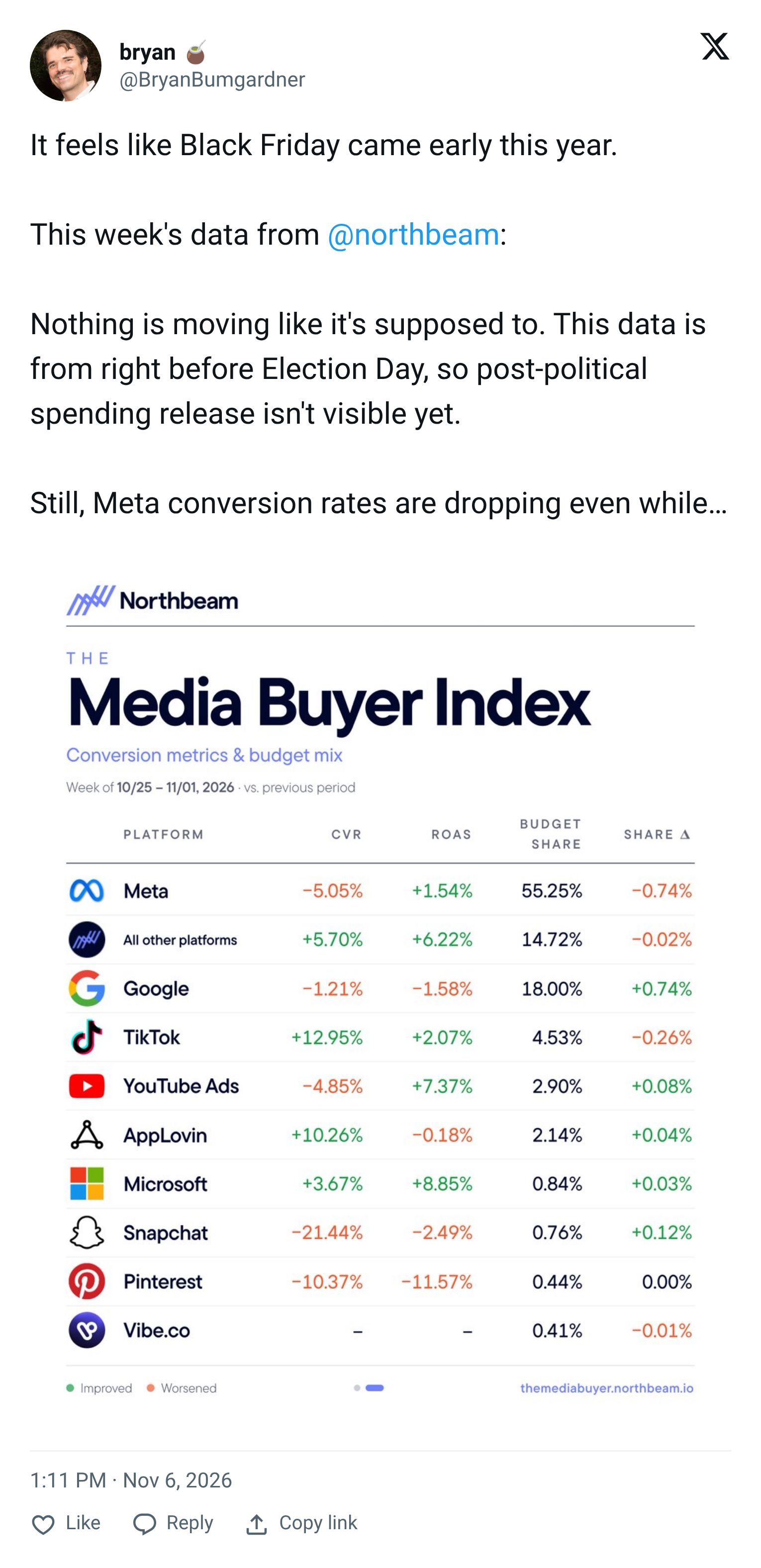
1/ The click may arrive before the buyer is ready
Bryan Bumgardner noticed CTR rising while conversion fell and wondered whether shoppers were waiting for a deal. That is a hypothesis, not a diagnosis. Compare the same audience and product before and after your offer goes live.
2/ Your pop-up is part of the sale
Max Sturtevant points to a common mismatch: a sitewide sale is live, but the welcome pop-up still promises a smaller first-order discount. Update the message when the promotion starts, and make sure old codes cannot stack unexpectedly.
Ideas Worth Stealing
Turn a seasonal product into a reason to browse

PopSockets sends Grinch-themed ads to one collection, not scattered product pages.
PopSockets’ Grinch ads promise holiday mischief for your phone. The destination gathers the matching cases and grips in one themed collection. A small accessory now feels like a seasonal gift choice, and the shopper can browse the whole idea at once.
Steal the structure: Give related products one timely theme and one page. The theme can come from a use occasion or your own creative world; it does not need licensed characters.
Daily Growth Rep
📦 Today’s Growth Rep: Test one gift order end to end
Why this works:
A gift shopper needs confidence that the item, delivery promise and checkout all agree.
One test order can reveal friction that does not show up in an ad report.
Your rep:
Pick the product you most want to sell as a gift and a common delivery destination.
Open the ad’s destination on your phone and go through checkout with that address. Note the delivery estimate, shipping charge and any gift options.
Fix one mismatch between what the ad or page promises and what checkout shows.
Report: Reply with the mismatch you found and the change you made.
In Case You Missed It
Ultra Hit a $100M Run Rate. Here’s Its Ad Formula. Its three-step ad structure is useful when your sale creative needs to do more than announce a discount. See the examples and the landing pages that complete each argument.